
A new quality manager starts their first week. They ask where calibration records live, where competency logs sit, and which SOP version is current. Three people give three different answers. This is what a lab quality manager transition looks like in most labs.
No one intends to create confusion. The previous quality manager built a system that worked. They knew where everything lived. They knew which spreadsheet mattered. They knew which version of a document to trust.
Then they left.
The system did not leave with them. The clarity did.
That is when a lab quality manager transition stops feeling like a staffing change and starts feeling like a system failure.
Lab Quality Manager Transition Exposes the Real System
Most labs believe they have a process problem when a new quality manager struggles. They assume the new person needs time to learn.
Time helps, but it does not fix the root issue.
The root issue is that the system lived in one person’s head.
When that person leaves, every shortcut, workaround, and unwritten rule becomes visible. A lab quality manager transition does not create gaps. It exposes gaps that already existed.
That is why the first weeks feel chaotic. Not because the new manager lacks experience, but because the system lacks structure.
What ISO 17025 Actually Requires
ISO 17025 requirements for laboratory management systems require labs to ensure competence, impartiality, and consistent operation.
Those requirements cannot depend on one person’s memory.
A lab cannot claim consistent operation if only one person knows how records are organized. It cannot prove competence if training records require explanation before they make sense.
During a lab quality manager transition, this becomes obvious fast. The new manager cannot rely on institutional memory. They need a system that stands on its own.
The 60–90 Day Catch-Up Trap
Most labs underestimate how long recovery takes.
Labs that rely on tribal knowledge and manual systems often spend the first 60 to 90 days of a lab quality manager transition catching up. The new manager tracks down missing records, verifies calibration status, and confirms which SOPs are active.
That is not quality management. That is reconstruction.
During that time, real risks grow:
- Calibration gaps go unnoticed
- Training status stays unclear
- SOP inconsistencies persist
- Corrective actions stall
The lab appears stable from the outside, but internally, control weakens.
This is where many labs feel audit risk rise.
Why “We Know Where It Is” Fails
Every lab has someone who says, “We know where everything is.”
That statement works as long as the same people stay in place.
During a lab quality manager transition, that confidence breaks down. Knowledge spreads across multiple people, and each person holds only part of the picture.
One person knows calibration files. Another knows training logs. A third knows document versions.
No one sees the full system.
That fragmentation creates delays, errors, and conflicting answers when auditors ask questions.
How LabMODO Keeps the System Intact
LabMODO was built for labs that want control without complexity. We focus on making the system visible and connected, not hidden in people.
Our platform keeps compliance running during a lab quality manager transition because it stores the system itself, not just the records.
Instead of scattered tools, you manage:
Calibration Records
Each instrument has a clear history with attached documentation.
Training and Competency
Training records connect to employees and methods without guesswork.
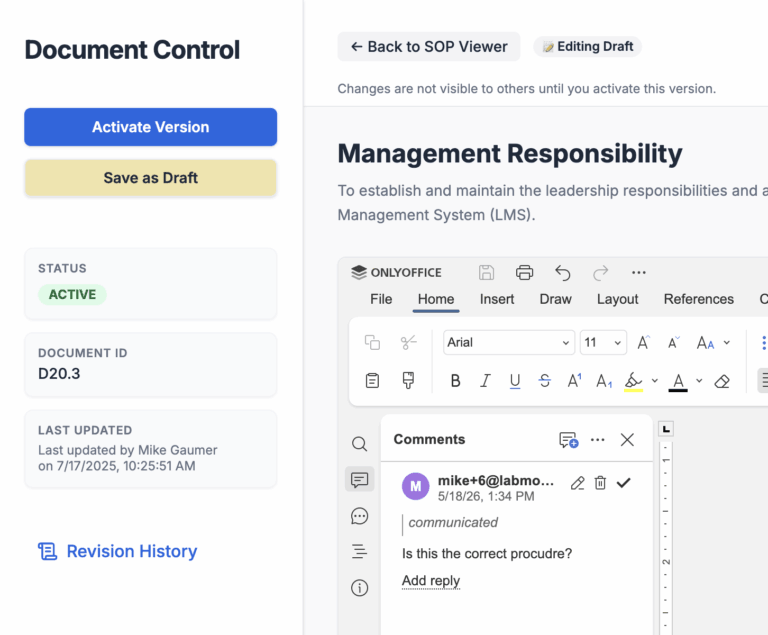
Document Control
SOP versions, approvals, and changes stay visible and consistent.
Corrective Actions
CAPAs have clear ownership and status.

Everything lives in one place. The system does not depend on memory.
See how our ISO 17025 compliance software supports lab continuity.
The Hidden Risk of a Strong Quality Manager
A strong quality manager can hide system weaknesses.
They keep everything organized. They answer questions quickly. They bridge gaps between disconnected tools.
That looks like success.
It also creates dependency.
When that person leaves, the lab loses not just a role, but the structure that held everything together.
A lab quality manager transition reveals whether the system stands on its own or depends on a single person.
What Auditors Actually Evaluate
Auditors do not just review documents. They evaluate how your system holds together.
They watch how your team retrieves information. They look for consistency across records. They check whether your documentation aligns across training, calibration, and procedures.
If your team hesitates or produces conflicting data, auditors dig deeper.
If your team retrieves a complete picture quickly, auditors move on.
Strong lab compliance management software supports that second outcome.
Building a System That Outlasts People
Labs do not need more procedures. They need systems that enforce those procedures.
That means:
- One source of truth for records
- Clear ownership of tasks
- Visible status across all compliance areas
- Easy retrieval of documentation
When those elements exist, the system continues without disruption.
A new manager steps in and operates, not rebuilds.
That is how you remove risk from a lab quality manager transition.
Audit Readiness Should Not Reset
Too many labs treat each new quality manager as a reset.
They rebuild documentation. They verify records. They clean up inconsistencies.
That cycle wastes time and introduces risk.
Audit readiness should persist through staff changes. It should not depend on who holds the role.
That is what ISO 17025 expects, and it is what strong systems deliver.
A well-built system makes a lab quality manager transition a non-event.
The Real Upgrade Is System Ownership
Most labs already do the work. They calibrate instruments, train staff, maintain SOPs, and manage corrective actions.
The problem starts when those activities depend on individuals instead of a system.
Lab quality manager transition challenges expose that gap.
The solution is not to find a better person. The solution is to build a better system.
When the system holds the structure, the lab holds control.
If your compliance process depends on one person to keep it running, it will break when they leave.
Book a live demo of LabMODO and see how we help labs build systems that survive every lab quality manager transition: https://www.labmodo.com/resources/iso-17025-compliance-software/