A QA manager discovers that an analyst used an expired reagent during a test run. In many quality systems, the next step happens automatically. Someone opens a CAPA. The team starts root cause analysis, assigns corrective actions, and schedules an effectiveness review. The full process begins. The problem is that ISO 17025 does not require that. The standard requires the lab to identify the issue, contain it, assess the impact, evaluate the significance, and then determine whether corrective action is warranted. *(ISO/IEC 17025:2017, Clause 7.10)* For a one-time human error with no evidence of a broader system failure, the answer is often no. This distinction matters more than most labs realize. When every issue becomes a CAPA, quality systems become noisy. Teams spend time investigating events that do not justify a full corrective action process. Genuine systemic issues get buried in a pile of administrative work. I have seen this happen in labs across the country. The issue is not that people misunderstand CAPAs. The issue is that many systems force everything into the CAPA workflow whether it belongs there or not. That is not how ISO 17025 expects labs to operate.
The Cost of Treating Every Issue Like a CAPA
Most quality systems collapse the process into one path:
Issue → CAPA
That feels safe. Nobody gets criticized for opening too many corrective actions.
But this approach creates two problems.
First, it increases administrative burden. Teams spend hours documenting investigations for events that could have been evaluated and closed.
Second, it makes it harder to identify what actually matters. When every nonconformance becomes a CAPA, the truly significant issues stop standing out.
Auditors and managers must sort through a long list of corrective actions to find the few that represent real risk. That creates noise.
Labs that route every nonconformance through a full CAPA process create administrative burden that obscures genuine systemic issues. It also makes it harder for auditors to identify what actually matters.
The result is more paperwork, more meetings, and less focus on quality.
What ISO 17025 Actually Requires
Most confusion comes from mixing two separate parts of the standard.
ISO 17025 requirements for testing and calibration laboratories address nonconforming work in Clause 7.10 and corrective actions in Clause 8.7.
Those clauses serve different purposes.
Clause 7.10 governs how the lab responds when something goes wrong. Clause 8.7 governs what happens when the lab determines corrective action is necessary.
That distinction matters.
ISO 17025 Clause 7.10 requires labs to do seven things.
- Identify the Issue. The lab recognizes that work departed from established requirements. This could involve an expired reagent, an out-of-calibration instrument, a missed procedural step, an incorrect standard, or another deviation from expected practice. The first job is not to investigate everything. The first job is to capture what happened clearly enough for review.
- Contain the Issue. The lab determines whether affected work should stop. Containment prevents additional impact while the lab evaluates the issue. Sometimes that means pausing a test run. Sometimes it means holding results. Sometimes it means removing a reagent, instrument, or method from use until someone completes the review. Containment is not the same thing as corrective action. It is the first control that keeps the issue from spreading.
- Assess Impact. The lab evaluates what the issue affected. The lab evaluates whether results, customers, or accreditation requirements were affected. That assessment matters because the same event can carry different levels of risk in different contexts. An expired reagent used in a noncritical check may require one response. The same reagent used in a reported customer result may require a different response. A good system preserves that analysis. It does not force the lab to jump straight to CAPA before impact is understood.
- Evaluate Significance. This is the step many systems skip. The lab determines whether the issue represents a one-time event or evidence of a broader system failure. This is where judgment matters. A one-time data entry error may not require a CAPA. A repeated data entry error across multiple analysts may point to training, procedure, or system weakness. The standard expects the lab to make that distinction. It does not expect the lab to treat both events the same way.
- Determine Whether Customer Notification Is Required. Some events require communication with customers. Others do not. The lab documents that decision. If results may be affected, customer notification may matter. If no customer impact exists, the lab should still document why. That record protects the lab later. It shows that someone evaluated the issue instead of ignoring it.
- Determine Whether Corrective Action Is Required. This is where Clause 8.7 enters the picture. Not every nonconformity requires a CAPA. ISO 17025 Clause 7.10 requires labs to evaluate significance before determining whether corrective action is warranted. If there is risk of recurrence or evidence of system failure, corrective action may be necessary. If not, the lab can document the event and close it. This is the point many software systems get wrong. They turn every nonconforming work record into a corrective action before the lab evaluates whether corrective action makes sense.
- Maintain Records. The lab maintains records of what happened, what impact it assessed, which decisions it made, and which actions it took. Those records should also include customer notifications and corrective actions when they apply. The record matters because the auditor may not just ask what happened. They may ask how the lab decided what to do next. That is the difference between a documented event and a defensible quality decision.
How LabMODO Handles Nonconforming Work
When we designed the nonconformity module in LabMODO, we started with the standard.
We did not start with software conventions.
That led us to a different workflow than most quality systems. LabMODO separates nonconformity intake and evaluation from corrective action.
That separation matters because it mirrors the standard.
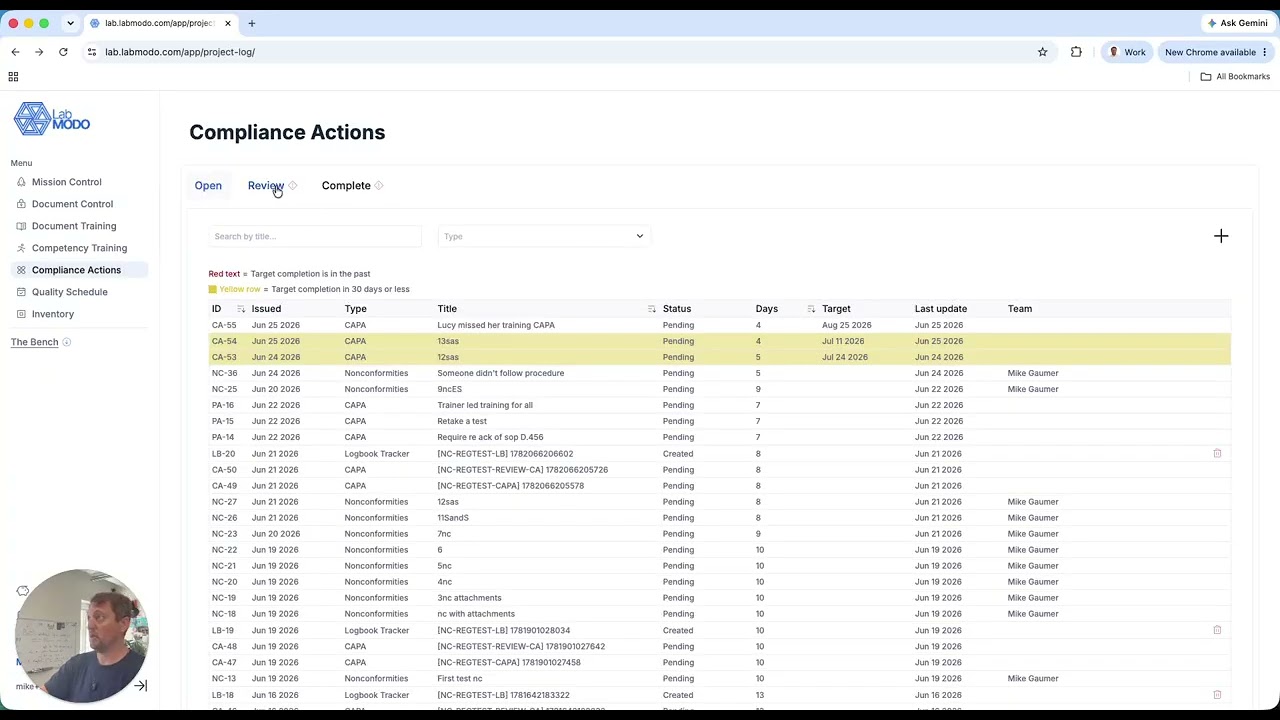
Step 1: Create a Nonconformity
A user identifies an issue and creates a new nonconformity record.
The system requires only two fields at intake:
– Title
– Issue description
The user can also provide additional detail:
– Date identified
– Source
– Departments affected
– Reported potential impact
– Results potentially affected
– Containment actions taken
– Suspected root cause
– Attachments
The status begins as **Pending**.
This matters because reporting should not feel like writing a full investigation. If intake feels too heavy, people delay reporting.
A good nonconformity process makes it easy to capture the issue first. The formal review comes next.
Step 2: Submit for Review
The user submits the record.
The status changes to **Submitted**.
At this point, the issue waits for review by an approver. No CAPA exists yet.
No assumptions have been made. The issue enters evaluation.
That is the correct sequence.
The lab captures the event, then reviews it. It does not decide the corrective action before it understands the significance.
Step 3: Approver Review
The approver performs the formal assessment.
This step preserves both perspectives. The original reporter’s assessment remains visible, and the approver records their own findings separately.
The approver documents:
– Official impact assessment
– Customer notification decision
– Notification status
– Notification notes
– Cause classification
– CAPA Required? Yes or No
Cause classifications can include:
– Human error
– Procedure issue
– Training issue
– Equipment issue
This step captures the core ISO 17025 decision.
Does this issue require corrective action?
Step 4A: No CAPA Required
Sometimes the answer is no.
The event occurred. The lab evaluated it.
The lab determined there is no evidence of recurrence risk or system failure.
The approver records the closure rationale. The status changes to **Closed**.
The workflow ends.
This is correct ISO 17025 handling for many one-time events. The lab documents the issue and the decision without creating unnecessary investigation work.

Step 4B: CAPA Required
Sometimes the answer is yes.
The approver determines that recurrence risk exists or that the issue reveals a broader system weakness.
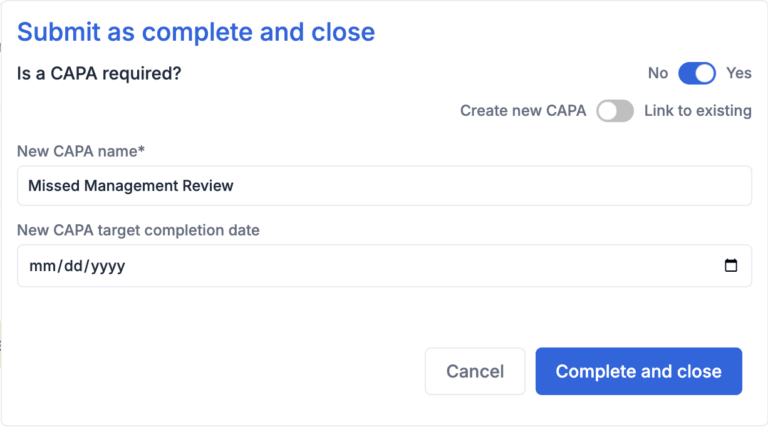
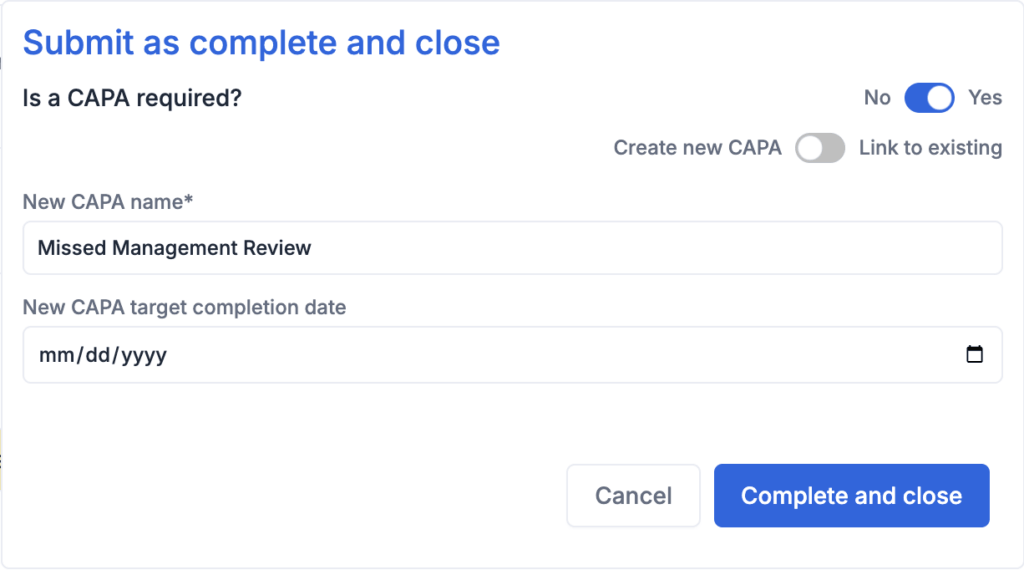
At that point, the approver can create a new CAPA or link an existing CAPA.
The nonconformity closes. The CAPA becomes the active workflow.
The issue moves from evaluation to corrective action.
That handoff matters because the CAPA should address the root cause. It should not exist only because something happened.

The Difference Most Systems Miss
Most quality systems follow this path:
Issue → CAPA
Everything becomes a corrective action.
LabMODO follows a different path:
Issue → Nonconformity → Review → CAPA Needed?
If no, the issue closes. If yes, the CAPA begins.
That difference reflects how ISO 17025 actually works. This separation between Clause 7.10 and Clause 8.7 is intentional in the standard, and it is intentional in LabMODO.
It also creates a cleaner quality system.
One CAPA can address multiple nonconformities.
For example:
– NC-001
– NC-002
– NC-003
can all connect to:
– CAPA-005
That works because CAPAs solve root causes, not individual events.
If three nonconformities point to the same training weakness, the lab should not create three separate CAPAs. The lab should link those nonconformities to one corrective action that addresses the shared cause.
This approach prevents duplicate investigations and keeps attention focused on systemic issues.
That is exactly how auditors expect mature quality systems to operate.
The goal is not to avoid documentation. The goal is to document proportionally. Every issue should be captured. Not every issue should trigger an investigation.
Why This Matters During Audits
Auditors want to see that the lab understands risk.
They do not expect every issue to become a corrective action. They expect the lab to evaluate issues consistently and make appropriate decisions.
A2LA accreditation requirements focus on whether the laboratory can demonstrate competence, consistency, and control.
A system full of unnecessary CAPAs can signal that the organization lacks a clear process for evaluating significance.
A system that separates nonconformity management from corrective action demonstrates maturity.
It shows that the lab understands the difference between documenting an event and addressing a systemic problem.
That distinction matters under ISO 17025.
It also helps the lab operate better between audits.
Quality managers should not spend their time managing unnecessary investigations. They should focus attention on the issues that create real risk.
Why Most Labs Get Pulled Into CAPA Overload
CAPA overload rarely starts with bad intent.
It usually starts with caution.
A lab sees an issue and opens a corrective action because that feels safer than closing the record after evaluation.
Over time, that habit becomes the system.
Minor events turn into investigations. Investigations pile up.
The team spends more time feeding the CAPA process than improving the lab.
That creates a second problem. People become reluctant to report small issues because they know each report may create weeks of work.
That is the opposite of a healthy quality system.
A healthy system encourages reporting, evaluates significance, and escalates only when evidence supports escalation.
That is how labs find problems earlier without drowning the team in unnecessary work.
Build the Workflow the Standard Requires
Every action has a reaction.
A nonconformity should trigger evaluation. Evaluation should determine whether corrective action is necessary.
Corrective action should begin only when the evidence supports it.
That is how ISO 17025 works.
LabMODO was built around that principle. The system connects nonconformities to CAPAs only when the standard requires it.
Every decision remains traceable. Every action remains documented.
Every record stays connected for the next audit.
If you are evaluating ways to strengthen your ISO 17025 quality system, book a demo and see how LabMODO manages nonconforming work the way the standard actually expects laboratories to operate: https://www.labmodo.com/resources/iso-17025-compliance-software/