
An ISO 17025 auditor asks for the full calibration history of a desktop centrifuge tied to a flagged test result. The lab manager opens three spreadsheets, clicks through a shared drive folder, and pulls a paper binder off the shelf. They find a certificate, then stop, because they cannot confirm it matches the version in effect on the test date. This moment pushes many labs toward iso 17025 calibration software.
Most labs think calibration breaks because someone missed a due date. They add reminders, build calendars, and still feel exposed when auditors start asking questions.
The real issue is traceability. When an auditor asks for the full history behind a specific result, reminders do not help. You need one connected record that shows the entire chain.
That is what iso 17025 calibration software should deliver.
ISO 17025 Calibration Software Fixes Traceability, Not Just Scheduling
ISO 17025 requirements for calibration traceability and equipment records require labs to maintain documented calibration records for all equipment used in testing or calibration. Those records must show traceability to national or international standards.
Auditors can request those records for any result at any time.
They do not ask if calibration exists. They ask you to prove it and connect it to a specific test result.
They may ask:
- Which centrifuge ran the test
- When you calibrated it
- Which standard you used
- Whether calibration stayed valid at the time of use
- Whether any out-of-tolerance event affected results
You cannot answer those questions with a reminder. You answer them with a full record that ties everything together.
That is why iso 17025 calibration software matters.
Why Spreadsheet Systems Break Without ISO 17025 Calibration Software
Spreadsheets track dates. Shared drives hold files. Paper logs capture signatures. None of these tools connect calibration events, certificates, and usage history into one view.
That gap creates risk during audits.
Labs that manage calibration through spreadsheets and shared drives usually cannot produce a complete instrument history in under five minutes during an unannounced request. The team searches across files while the auditor waits.
A2LA calibration laboratory accreditation requirements emphasize traceability and documented control. Slow retrieval signals weak control, even when the work exists.
Your team does not lack effort. They already perform calibrations, store certificates, and log events.
They lack a system that connects those records.
That is where iso 17025 calibration software changes the outcome.
What a Complete Calibration Record Looks Like
A complete record tells a clear story from calibration to result.

When an auditor asks about a centrifuge, your system should show:
- The instrument ID and location
- Every calibration event with dates and outcomes
- Certificates attached to each calibration
- The standards used for traceability
- Any adjustments or failures
- The tests performed while the instrument remained in tolerance
That is not a collection of files. That is one record.
Strong iso 17025 calibration software builds this structure so your team does not have to assemble it during an audit.
How LabMODO Replaces the Spreadsheet Chase
LabMODO was built for testing and calibration labs that need control without enterprise overhead. We focused on the exact point where audits break: disconnected calibration records.
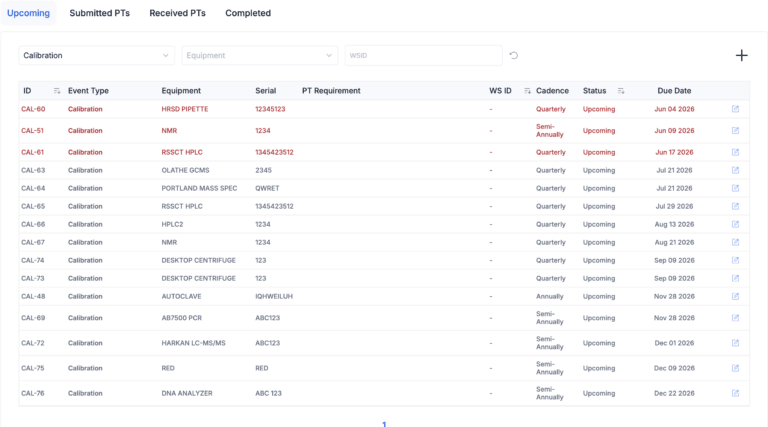
Our iso 17025 calibration software gives you one system to manage instruments, calibration events, and documentation together.
Instead of switching between tools, your team can:
Manage Instruments in One Place
Each asset has a single record with its full history.
Track Status Without Searching
You can see which instruments are current, due, or overdue at a glance.
Retrieve Full Histories Instantly
You can answer auditor questions without chasing files.
You already capture this information. LabMODO connects it.
Explore our ISO 17025 compliance and calibration management platform.
The Risk of “We Know Where It Is”
Most labs rely on experience to fill system gaps.
Someone knows which spreadsheet holds the latest dates. Someone knows where certificates get stored. Someone knows which binder has signed records.
That knowledge keeps things moving until it does not.
When that person is out or leaves the lab, the system breaks. Audit readiness should not depend on memory.
Good iso 17025 calibration software removes that dependency. It puts control inside the system so any team member can retrieve the right record at any time.
What Auditors Notice First
Auditors watch how quickly your team responds.
They look for clear, consistent records. They look for calibration history that matches usage and documentation.
They also notice hesitation and conflicting files.
When your team retrieves a full history in under a minute, the audit moves forward. When your team searches across systems, the auditor starts asking more questions.
Strong iso 17025 calibration software supports that first scenario.
Why Labs Hesitate to Adopt New Systems
Many labs expect software projects to take months. They picture long setups, outside consultants, and IT barriers.
That concern makes sense if the system was built for a different industry.
Independent labs need tools built for their size and workflow. They need systems they can set up without waiting on IT.
The right iso 17025 calibration software should let your team start with instruments and calibration records, then expand as needed.
If you cannot get value quickly, the system will not stick.
Calibration Readiness Happens Every Day
Audit readiness does not start before the audit. It shows up in daily record management.
When calibration records stay current and connected, audits become routine checks.
When records scatter across files and logs, audits become search exercises.
That is why teams move to iso 17025 calibration software. They want control every day, not just before an audit.
The Real Upgrade Is Traceability
Your lab already does the work. You calibrate instruments. You store certificates. You document results.
The problem starts when you need to connect those pieces under pressure.
iso 17025 calibration software replaces scattered records with one system that shows the full history in seconds.
If your team still relies on spreadsheets, shared drives, and binders to explain calibration history, you are one audit question away from a scramble.
Book a live demo of LabMODO and see how our iso 17025 calibration software helps accredited labs stay audit-ready without the spreadsheet chase: https://www.labmodo.com/iso-17025-compliance-software